
Brand Architecture After a Merger: Who Keeps the Name?

A brand merger brings two businesses together, but getting the consumer-facing brand identities to follow suit is another matter.
Afterwards comes the slightly awkward question of what to do with the brands. Keep both? Pick a favourite? Invent an entirely new name?
Too often, companies approach brand architecture as a practical exercise rather than a strategic one. They focus on streamlining brand identities before deciding what they're streamlining towards, while others put the decision off entirely.
It's tempting to treat brand architecture as a tidying-up exercise but before deciding what stays and what goes, there's a more important question to answer: where is the business actually going?
What is brand architecture?
Brand architecture is the way a company organises its brands, products and services. It determines how they relate to one another, how they're presented to customers, and where the value of the parent brand sits.
It becomes particularly important after a brand merger or acquisition, when businesses with their own identities come under one roof.
There are three main models, each with their own logic:
1. Branded house
One brand rules the roost. Every product or service sits under the same name, borrowing from its reputation and adding to it in return.
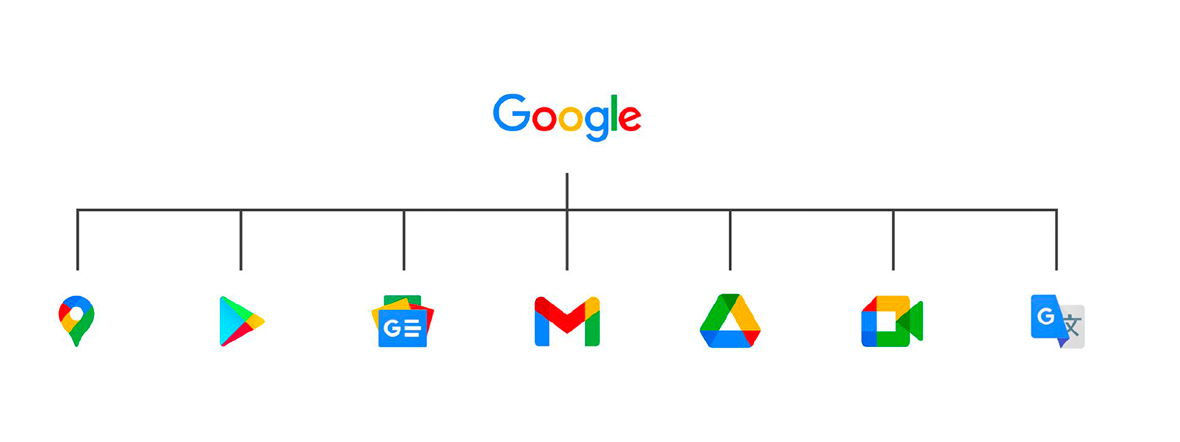
Take Google. Google Maps, Google Drive, and Google Meet are all different products under one instantly recognisable brand.
The upside is that it’s a tidy arrangement: it’s easier to manage, easier to recognise, and easier to launch something new. Each product strengthens the same brand, rather than building its own reputation from scratch.
However, there's nowhere to hide. If one product takes a reputational hit, the rest of the business can feel it too. And with everything under one name, there's less room to give individual offerings their own personality.
2. House of brands
Each brand has its own identity, positioning and audience, with little visible connection to the parent company.
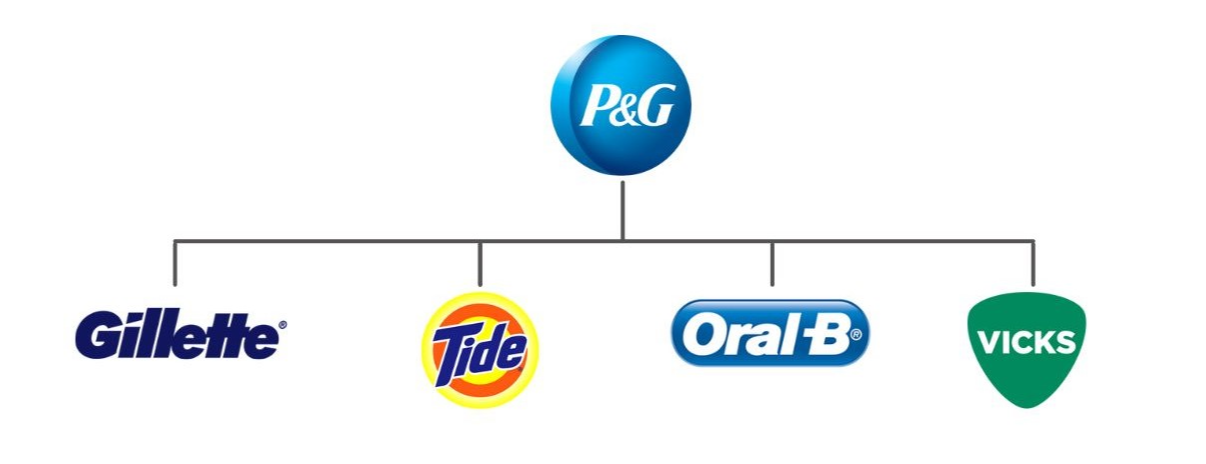
Under Procter & Gamble, brands like Gillette, Pampers and Tide operate with distinct identities and market positions. Rather than relying on the parent company's reputation, each has the freedom to respond to different audiences and needs.
The trade-off is complexity. Multiple brands require separate strategies, marketing budgets and ongoing management. Without a shared name doing some of the heavy lifting, each must build recognition on its own terms.
3. Hybrid architecture
Some brands share the parent company's name, while others retain their own identities, with varying degrees of connection to the wider business.
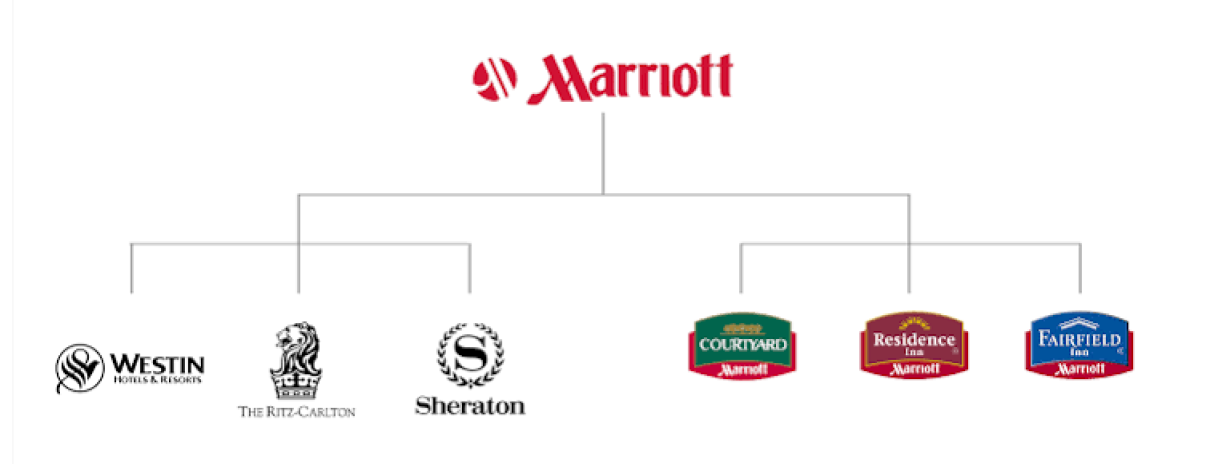
Marriott International is a good example. Marriott Hotels carries the parent name, while the Ritz-Carlton has its own identity built around luxury and a particular level of service. Then there's Courtyard by Marriott, which uses the parent name as an endorsement while maintaining a distinct offering for a different audience.
The benefit is Marriott can serve different markets without forcing every hotel into the same identity. Established brands retain their reputation and appeal, while others benefit from the recognition of the parent company.
The challenge is keeping it coherent. Without a clear strategy, a hybrid structure can become a collection of brands with no obvious relationship.
Which brand architecture is best after a merger?
Understanding the different models is one thing, but deciding which makes sense for your business is another.
If two companies are coming together to offer one service, a single brand is often the logical choice. If they serve distinct audiences with different needs, retaining separate identities could create more value.
However, if customers have spent years building trust in an established name, retiring it too quickly risks losing much of that goodwill.
Ultimately, the decision is about understanding what each brand brings to the combined business, and which structure will serve it best in the years ahead.
Brand architecture examples
If your priority is...
Consider...
Examples
Building one clear market position
A branded house
Google, BBC, Apple
Serving distinct audiences or markets
A house of brands
Procter & Gamble, Diageo, L'Oréal
Retaining trust while creating a stronger parent brand
A hybrid or endorsed structure
Marriott International, Microsoft, Volkswagen Group
Moving towards one identity without losing recognition
A phased transition
VodafoneThree, Virgin Media O2
How to approach the architecture after a brand merger
The best time to address brand architecture is early, while the future direction of the business is still being shaped.
Start with the strategy. Develop a brand strategy to understand what the combined business wants to become, which markets it plans to enter, and how its products or services might evolve.
Bring the right people into the conversation. Leadership matters, but so do sales, marketing, product and development teams. Each sees different implications of the decision.
Listen before announcing. Speak to key clients and employees. Understand what they value, what they associate with each brand, and what they might be reluctant to lose.
Map the implications. A brand merger affects far more than visual identity. Websites, product interfaces, documentation, signage, sales materials and customer communications all need consideration.
When done well, brand architecture gives leadership a clearer direction, employees a shared understanding of what they're building, and customers a reason to believe in what comes next.
A poorly considered brand structure can confuse customers and leave the combined business competing with itself. Not quite the outcome anyone had in mind.
Planning a brand merger or navigating one already? We help businesses make sense of change, from brand strategy and architecture to identity and implementation. Book a call to discuss what's next.